Chapter 8 — Participation: Subjects, Acts, and Consequences¶
Abstract¶
This chapter develops the human-side analytic architecture within a reciprocal theory of Participation in the Unified Gradual AGI Model. The larger thesis is that Gradual AGI is increasingly realized through reciprocal participation between AI systems and humans: AI capabilities and outputs alter the tasks, options, norms, and environments within which humans act, while human acts shape the conditions, uses, verification, governance, and values under which AI contributes. Reciprocity does not imply symmetry or equivalent agency, intentionality, standing, or responsibility. Reciprocity is instantiated in part through Participatory Role Plasticity: AI systems may move from instrument-like use into active actor roles within a shared task, while human Participatory Subjects can continue to initiate or authorize the task and guide its objectives, values, evaluation, and institutional responsibility. For empirical tractability, the chapter operationalizes the human side through Participatory Subject, Participatory Act, and Participatory Consequence so that presence is not confused with action and action is not confused with influence or realization change. A minimal Relational Grammar distinguishes acts by Realization Orientation, Foreclosure Position, and Actor Dependence, while Proposition A states a Conditional Non-Fungibility rule for comparing acts. Recognition and Uptake locate intermediate processing states; Participatory Configuration represents multi-act structure; and Proposition B develops Participatory Role Plasticity under automation. The chapter defines Responsive Floor as an evidence-conditioned realization classification and treats Proposition C as an architectural admissibility claim about possible non-veto participatory dependence. Participation is not added as a fifth argument of the realization mapping. Empirical adjudication remains Chapter 9’s burden.
Keywords. Gradual AGI; participation; Reciprocal Theory of Participation; Reciprocal Participation; Participatory Subject; Participatory Act; Relational Grammar; Conditional Non-Fungibility; Participatory Role Plasticity; Responsive Floor; human agency; realization
Scope note¶
Chapter 8 owns the conceptual architecture of Participation. At the book level, Gradual AGI as Participation is reciprocal: AI systems and humans can both participate in an evolving realization process and can change the conditions under which the other participates. The technical Subject-Act-Consequence apparatus in this chapter operationalizes the human side without implying that AI participation is absent or that the two sides are symmetrical. Chapter 9 owns empirical adjudication of that human-side apparatus: the 3M Taxonomy, M1-M8 Act Form codes, Frame One, consequence classes, pathway evidence, reliability, nulls, temporal findings, and aggregate-floor adjudication. Chapter 8 therefore defines the reciprocal thesis and the human-side distinctions to be tested; it does not use later empirical results to validate its own definitions.
Chapter 8 Reader Guide¶
Participation: Subjects, Acts, and Consequences
One-line summary¶
This chapter develops a human-side analytic apparatus within reciprocal human–AI Participation, distinguishing who participates, what they do, and what follows.
Principal Contributions¶
This chapter makes the following principal contributions. It formulates conceptual distinctions and testable claims; empirical adjudication belongs to Chapter 9.
-
Reciprocity without symmetry. Humans and AI systems can both participate in realization and alter the conditions under which the other participates. The human-side apparatus makes empirical inquiry tractable without excluding AI participation or asserting equivalent agency, standing, responsibility, or moral status.
-
Participatory Subject, Act, and Consequence. The chapter distinguishes presence from intentional action and action from its consequences. Subject, actor, and instrument are analytical roles rather than interchangeable labels.
-
A Relational Grammar and Conditional Non-Fungibility. Realization Orientation (RO), Foreclosure Position (FP), and Actor Dependence (AD) distinguish acts beyond their visible form. Proposition A states conditions under which apparently similar acts should not be treated as interchangeable.
-
Recognition, Uptake, and participatory configuration. Intermediate processing states and multi-act relationships locate where action enters a process and where conversion toward consequence may stop. Recognition does not entail Uptake or realization change.
-
Role Plasticity and participation-sensitive realization. Proposition B addresses changing participatory roles under automation. Proposition C states an architectural admissibility claim about possible realization dependence without participant veto authority. Responsive Floor supplies an evidence-conditioned realization classification rather than a guaranteed outcome.
Prerequisites¶
Chapter 4 supplies the realization architecture; Chapter 7 distinguishes institutional possibility from participatory action. Chapters 1–2 provide the system and beneficiary frame. The Relational Grammar is introduced here in the order RO → FP → AD; this displayed order does not make the profile a temporal process.
Reading routes¶
Subject and act path. Sections 8.1–8.3 establish reciprocal Participation and the human-side Subject and intentional Act used for empirical analysis.
Grammar and consequence path. Sections 8.4–8.6 develop the Relational Grammar, Conditional Non-Fungibility, and Recognition, Uptake, and consequence.
Dynamic and realization path. Sections 8.7–8.9 examine Role Plasticity, Participation-Sensitive Realization, Responsive Floor, and the framework’s limits.
Book path. Within Part III, Mediation, Chapter 8 provides the conceptual architecture that Chapter 9 brings into empirical contact. Chapters 10–11 then constrain the evidence claims and examine temporal return and changing roles.
Evidence and limits¶
An AI-drafted act can remain attributable to a human who deliberately reviews, adopts, and submits it; automated output alone does not establish human intentional action.
Conceptual admission is not empirical confirmation. The chapter’s illustrations do not establish the prevalence, causal effect, or general success of Participation. Intentional acts need not become consequential; consequential acts need not alter realization.
Reciprocity does not imply symmetry, and possible AI actor roles do not settle artificial moral status or institutional responsibility. Responsive Floor is not an index of participation volume or a universal guarantee of responsiveness. Participation does not become a fifth argument of the realization mapping. Later empirical findings must not be read backward as validation of the chapter’s definitions.
8.1 From Governance to Participation¶
Chapter 7 ended with a boundary. Governance identifies the structures through which realization can be contested: authority, standing, observation, steering, adjudication, recourse, and institutional contestability. But the existence of those structures does not tell us whether anyone actually acts through them. A public-comment process can exist without receiving a consequential submission. A professional body can possess authority to issue guidance and remain silent. A community can possess standing while lacking the information or organization needed to exercise it. Conversely, people can act outside the channels that Governance has formally created: they can organize, resign, refuse, petition, litigate, publish, build alternatives, or create institutions of their own.
At the book level, Participation asks how AI systems and humans enter realization, how their contributions change one another’s roles and conditions of action, and what—if anything—follows. For empirical tractability, the formal Subject-Act-Consequence apparatus below specifies the human side of that reciprocal relation.
8.1.1 Institutional possibility is not action¶
Standing concerns whether a human subject is entitled or recognized as able to enter a governance process. Participatory Readiness concerns whether that subject can recognize a realization-relevant issue, form a position or claim, and undertake an intentional act. Human Participation begins only when an attributable human subject actually acts with respect to a realization or to the conditions under which that realization is selected, maintained, redirected, revised, or challenged. Someone can possess standing but lack readiness; possess readiness and choose not to act; or lack formal standing and still undertake an observable act of refusal, organization, public contestation, or exit. AI-side participation is analytically separate from this standing/readiness sequence and is treated functionally through the tasks, outputs, decisions, or interactions by which an AI system enters the shared realization process.
Standing ≠ Readiness ≠ Participatory Act
8.1.2 The reciprocal thesis and the human-side architecture¶
The book’s Participation thesis is reciprocal. AI systems and humans can both participate in the evolving realization process, and participation on either side can alter the opportunities, constraints, roles, standards, and subsequent actions available to the other. Reciprocity is relational rather than symmetrical: it does not require equivalent intentionality, moral status, standing, responsibility, or authority. Within that broader thesis, Chapter 8 uses a deliberately simple human-side analytic sequence because the empirical questions of standing, readiness, intentional action, recognition, uptake, and non-veto consequence are specifically human and institutional questions.
Participatory Subject → Participatory Act → Participatory Consequence
Within this human-side architecture, a Subject can exist without acting. An Act can occur without producing a detectable consequence. A Consequence can occur without changing the realized condition. Much of Chapter 8 follows from refusing to collapse those objects. The reciprocal thesis adds a surrounding relation: AI participation can change the setting in which these human transitions occur, and human Participation can change the conditions under which subsequent AI participation occurs. Figure 8.1 preserves the human-side analytic sequence and makes its non-entailing transitions visible.
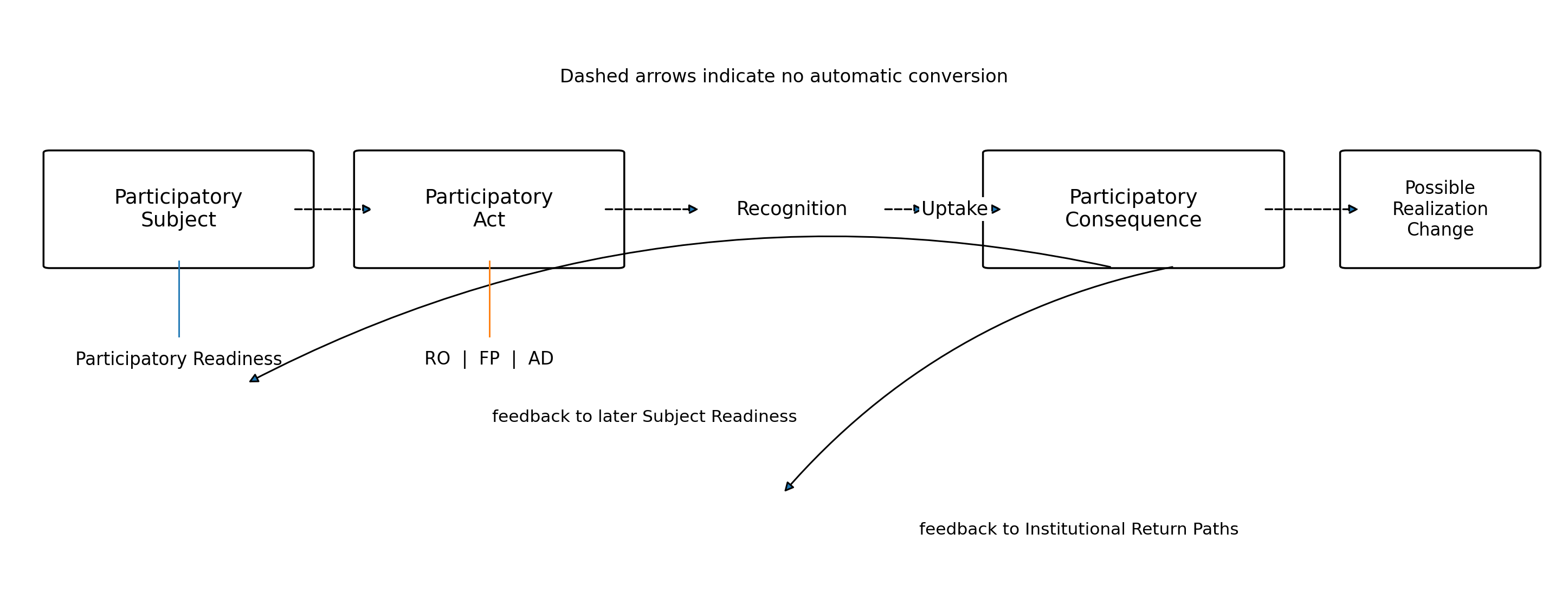
Figure 8.1. The Participation Architecture. The figure depicts the human-side analytic sequence within the broader reciprocal human-AI Participation thesis. Dashed arrows indicate that no forward conversion is automatic; consequences may feed back into later Subject Readiness and institutional return paths.
8.1.3 Mathematics as a live illustration¶
The 2026 mathematics debate is useful precisely because it contains many distinct Participatory Acts rather than a single binary controversy. The Leiden Declaration on Artificial Intelligence and Mathematics, released June 2, had attracted more than 4,000 signatories by September 15 and was endorsed by the International Mathematical Union (Leiden Declaration on Artificial Intelligence and Mathematics 2026). Its recommendations concern disclosure, verification, attribution, human responsibility, publication and review rules, tool choice, institutional policy, and the conditions under which mathematicians should collaborate with or withdraw from AI-related work. The European Mathematical Society chose not to endorse the Declaration formally while explicitly recognizing the importance of the issues and calling for continued attention to both risks and opportunities (European Mathematical Society 2026). The field is therefore not converging on one simple pro-AI or anti-AI position; it is actively negotiating the terms of participation.
Other 2026 developments make that participatory plurality concrete. The Association for Human Mathematics (AHM) asks members to refrain from supplying technical labor, mathematical knowledge, consultation, or publicity to commercial AI companies and from publishing AI-generated mathematical texts; an optional AI-free caucus additionally refuses AI use in core research activities such as finding proofs, exploring examples, and posing questions (Association for Human Mathematics 2026). The September 11 Fields Medallists declaration, initially signed by twenty-five Fields Medallists, argues that whether AI ultimately benefits or damages mathematics will depend substantially on human decisions about how the technology is used (Fields Medallists 2026; Schuler 2026). Meanwhile, journal and professional policies are beginning to allocate roles explicitly: the London Mathematical Society permits declared AI use for generating ideas, calculations, and constructing or verifying proofs, but does not permit AI to be an author and keeps responsibility with human authors (London Mathematical Society 2026).
Taken together, these developments are better represented as a participatory field than as a single controversy. Mathematicians may adopt AI, condition its use, verify it, disclose it, restrict it, refuse it, organize around it, redesign professional rules, or contest the institutional terms under which it enters the discipline. AI systems may in turn search, generate candidate solutions, conjectures, evaluations, or verification steps, thereby changing what human participants do next. Human acts then alter the conditions under which subsequent AI participation occurs. This is the reciprocal sense in which the book uses the thesis Gradual AGI as Participation. It does not imply symmetry or human-equivalent agency for AI systems. The Participatory Subject-Act-Consequence apparatus that follows is the human-side operationalization within this broader reciprocal process. Figure 8.2 summarizes this asymmetrical reciprocal architecture and the role plasticity through which human and AI participation can mutually condition subsequent acts.
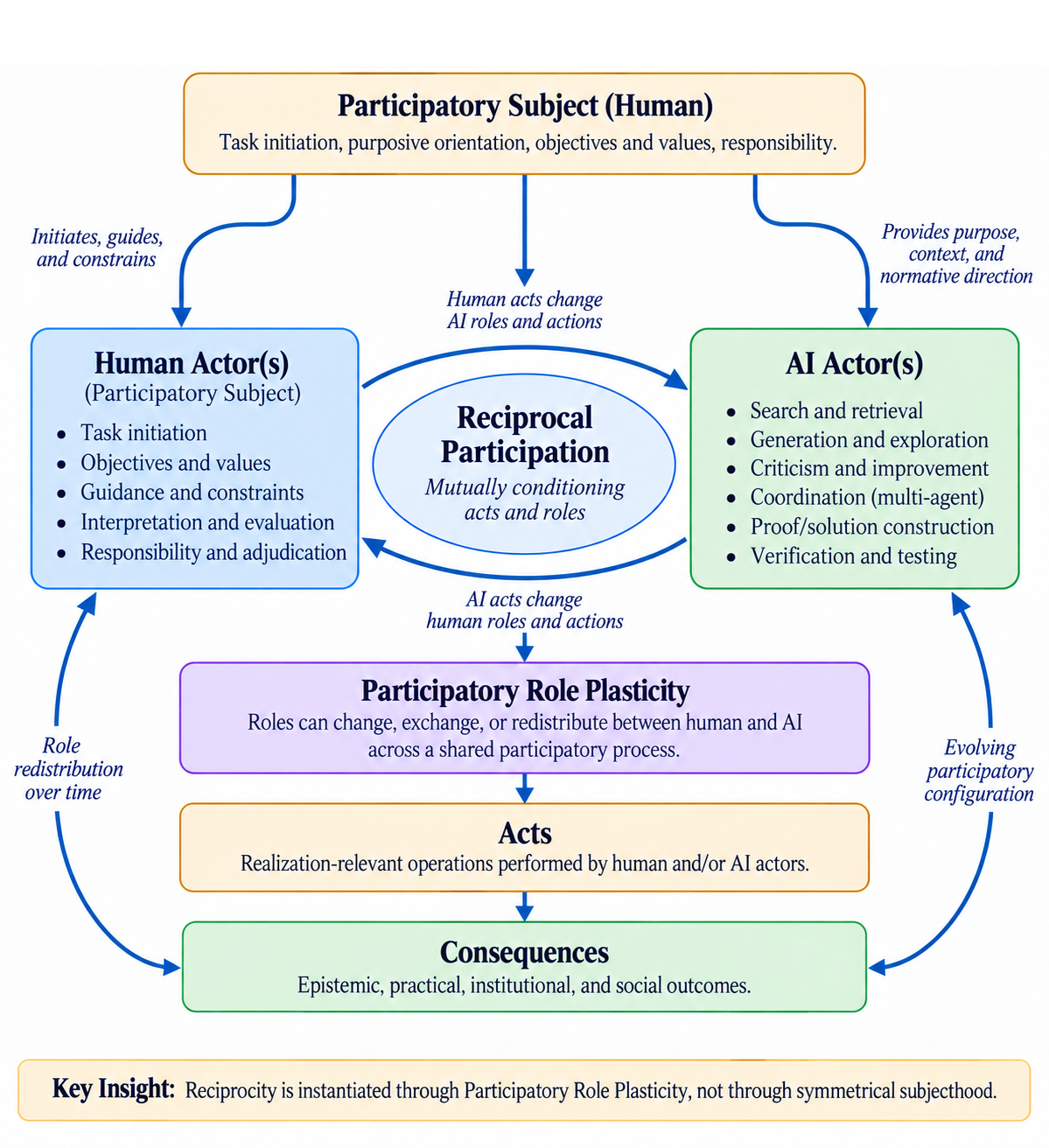
Figure 8.2. Reciprocal Theory of Participation and Participatory Role Plasticity. The human Participatory Subject retains task initiation, purposive orientation, objectives and values, evaluation, and responsibility, while human and AI actors can occupy changing roles and perform mutually conditioning acts. Reciprocity is instantiated through Participatory Role Plasticity rather than symmetrical subjecthood.
8.1.4 Participation begins before influence¶
The framework defines Participation at the level of intentional action rather than successful influence. If Participation were defined only by success, ignored petitions, rejected testimony, failed boycotts, unsuccessful resignations, and unanswered professional declarations would disappear from the theory. That would select on the outcome. Participation can therefore occur without binding authority, uptake, or realization change. Power affects what follows; it does not define whether the act occurred.
The remainder of the chapter asks three questions: who occupies the participant position; what structurally characterizes an act once it occurs; and what follows. Those questions cannot be compressed into a universal participation score. Counts of comments, signatures, meetings, members, or protests can be useful, but they do not by themselves preserve the structure of Participation.
8.2 The Participatory Subject¶
The human-side empirical architecture requires a subject before it requires an act. Yet human beings can be present in, affected by, or causally connected to an AI realization without intentionally participating in it. The first human-side question is therefore not who is present or who is affected. It is who can occupy the Participatory Subject position.
8.2.1 Definition — Participatory Subject¶
A Participatory Subject is a human person or human-organized collective capable of undertaking intentional action with respect to a prospective, ongoing, or realized condition of Gradual AGI.
Participatory Subject is intentionally a human-side technical term. That restriction does not deny AI participation in the broader reciprocal thesis. AI systems can recommend, filter, persuade, generate, negotiate, monitor, search, verify, and otherwise alter realization processes; those functions may be central to what is realized and may reorganize human roles around them. Chapter 8 does not infer from such AI participation human-equivalent intentionality, standing, responsibility, or authority. A human can also participate through an AI system when the relevant intentional act remains attributable to the human person or human-organized collective.
8.2.2 Collective subjects¶
Participation is often organized rather than individual. A neighborhood association can submit a petition; a union can negotiate conditions; a professional society can issue guidance; a university can redesign policy; a public-interest organization can litigate. Calling such a body a Participatory Subject does not imply a unitary mind. It means an act can be attributed to the collective through an identifiable human-organized process such as an authorized statement, adopted rule, vote, bargaining decision, institutional filing, or formal membership commitment. Internal disagreement can remain real while collective action remains attributable.
8.2.3 Contribution, affectedness, standing, and authority¶
Human-originated material is everywhere in AI development: data, writing, images, software, labor, feedback, infrastructure, and cultural material. Contribution alone does not establish Participation. A person’s writing can enter a training corpus without the author intentionally acting toward that realization; a worker can generate data while performing ordinary duties without taking a position on the surrounding AI process. The intentionality requirement keeps Participation from becoming another name for human causal involvement.
Affectedness is equally important but equally distinct. A resident can bear noise, water demand, traffic, or tax effects from an AI-related infrastructure project without undertaking any intentional act concerning it. A worker can experience automation without contesting or negotiating the change. Affectedness can ground governance standing, but standing is not action. Conversely, a person need not be directly affected to become a Participatory Subject: experts, researchers, advocates, consumers, citizens, and professional communities can act toward realizations whose immediate material burdens fall elsewhere.
Subject status, standing, and authority must therefore remain separate. Subject status identifies an eligible human actor capable of intentional realization-directed action. Standing identifies a recognized basis for entry into a governance process. Authority identifies the capacity to impose or bind a decision. The same actor may possess all three, but none entails the others.
8.2.4 Participatory Readiness¶
Participatory Readiness is the capacity of a potential Participatory Subject to recognize a realization-relevant issue, form a position or claim concerning it, and undertake an intentional Participatory Act.
Readiness is a capacity, not an act and not a proxy for willingness. Someone may be fully capable and rationally choose silence, delegation, exit, strategic non-engagement, private adaptation, or acceptance. Absence of observed participation can therefore reflect unreadiness, lack of standing, lack of opportunity, distrust, cost, deliberate silence, invisible private action, or other explanations. Non-participation does not diagnose incapacity by itself.
8.2.5 Readiness is realization-relative and time-sensitive¶
Readiness is not a permanent personal trait. A local official may understand land-use procedure deeply while lacking the expertise needed to evaluate frontier-model behavior. A mathematician may be ready to evaluate mathematical reasoning while lacking knowledge of environmental permitting. The relevant object is a subject’s capacity with respect to a realization at a particular time. This relation can be denoted schematically as PR(s,r,t), but the notation is explanatory rather than a universal readiness score.
Readiness is also information-constrained. Proprietary systems, trade secrecy, technical complexity, unequal access to expertise, and other forms of structural opacity can prevent otherwise capable subjects from recognizing what is at stake. Low observed readiness should therefore not be interpreted automatically as an intrinsic limitation of the Subject.
Readiness must also be separated from temporal opportunity. A community can become ready only after contracts, permits, land acquisition, financing, or construction have narrowed substantively different alternatives. Conversely, a decision can remain open while potential participants lack the capacity to recognize what is at stake. Readiness belongs to the Subject; Foreclosure Position, introduced below, belongs to the Act’s relation to the decision state.
8.2.6 Readiness can change¶
Education, technical translation, organizational experience, legal knowledge, and collective organization can increase readiness. Information overload, procedural complexity, rapid technological change, exhaustion, and repeated unsuccessful participation can reduce it. Earlier participation can itself change later readiness: an intentional act at time t can create knowledge, organization, or fatigue that becomes part of the participant environment at time t+1. This is the first local form of recursion, but the chapter stops short of a model-wide feedback theory.
8.3 The Participatory Act¶
The Subject layer ends at capacity. Participation begins when the subject intentionally does something with respect to an identifiable realization or to the conditions under which it is selected, maintained, redirected, revised, or challenged.
8.3.1 Definition — Participatory Act¶
A Participatory Act is an intentional action by a Participatory Subject directed toward a prospective, ongoing, or realized condition of Gradual AGI, or toward the conditions under which such a realization is selected, revised, maintained, redirected, or challenged.
Three elements are load-bearing: an action must occur; the action must be attributably intentional at the relevant human or human-organized level; and it must be directed toward an identifiable realization or realization condition. Success, institutional recognition, binding authority, and complete causal understanding are not required. Intentionality concerns the direction of the act, not omniscience about its downstream effects.
Within this chapter’s human-side apparatus, AI assistance does not by itself determine to whom an act is attributed. An AI-drafted comment that a person deliberately reviews, adopts, and submits can constitute that person’s Participatory Act. Automatically generated or transmitted output, without attributable human intentional action, does not qualify on that basis alone. This distinction concerns attribution within the operational apparatus; it does not deny AI participation in the broader reciprocal thesis, and it establishes neither effective uptake nor a consequential change in realization.
8.3.2 Participation is narrower than human contribution and broader than formal governance¶
The definition preserves two boundaries simultaneously. Human causal contribution without realization-directed intentionality is not enough. But formal institutional participation is not required either. A Participatory Act can occur through testimony, petition, voting, negotiation, refusal, resignation, boycott, litigation, professional organization, collective declaration, public advocacy, withdrawal of expertise, creation of alternatives, or other intentional action. Some acts occur inside formal governance; others occur around or against it. The channel affects what may follow, but it is not constitutive of the act.
8.3.3 The realization referent¶
A Participatory Act must be directed toward something sufficiently identifiable: a deployment, infrastructure project, institutional AI policy, professional norm, model-release practice, labor transition, educational use regime, research practice, or another realization condition. Generic sentiment is not automatically an act. A person can believe that AI is dangerous, beneficial, overhyped, or transformative without undertaking any action toward a realization. Sentiment can shape later behavior, but Participation begins when it becomes attributable action.
Diffuse or aggregate sentiment can still matter causally without constituting Participation. Where it alters markets, labor availability, institutional behavior, exposure, or another realization condition, it should be represented through the existing realization condition actually changed rather than reclassified as a Participatory Act or assigned automatically to any one realization variable.
One act can address several overlapping referents. A mathematician joining AHM may simultaneously act with respect to commercial collaboration, AI use in research, publication norms, professional identity, and the broader trajectory of AI-mediated mathematics. The analysis should specify which referent is under examination rather than forcing all of them into one undifferentiated object.
8.3.4 Visible Form is descriptive, not structural¶
Every Participatory Act has an observable Visible Form: testimony, petition, resignation, refusal, vote, lawsuit, declaration, purchase, boycott, membership decision, public comment, protest, curriculum redesign, or another recognizable event. Visible Form answers what happened. It does not fully specify how the act sits in relation to realization. Two public comments can share the same form while one supports a realization and another redirects it; two declarations can occur at very different degrees of decision foreclosure; two technical submissions can differ in whether their evidentiary content depends on the particular actor.
The term Act Form is deliberately reserved for Chapter 9’s empirical M1-M8 apparatus. Chapter 8 uses Visible Form only as an ordinary descriptive layer, not as a fourth grammar dimension.
8.3.5 Refusal and exit can be acts¶
Non-action should not be confused with intentional refusal. A person who simply does not use an AI tool may be absent from the observed realization process. A person who deliberately refuses its use because of an identifiable realization-directed position may undertake a Participatory Act. Exit has the same structure. Private adaptation can remain outside the framework, while publicly or institutionally directed exit can become participation when it is attributable, intentional, and realization-directed.
8.3.6 One episode can contain multiple acts¶
Real episodes often contain a sequence of acts rather than one event. A professional association can form, adopt membership commitments, establish a caucus, issue a statement, organize working groups, lobby institutions, and later change professional practices. Treating all of those as one observation would lose important distinctions. The framework therefore permits A1, A2, …, An within one episode and later represents their pattern through a Participatory Configuration.
8.3.7 Classification should not inherit the outcome¶
The act must be described from evidence about the act itself and the decision state it enters. Later success or failure must not rewrite what the act was. An ignored petition remains a Participatory Act. A declaration that later becomes influential was not necessarily “more participatory” at issuance. Wherever evidence permits, act classification should therefore be fixed independently of later consequence. Chapter 9 turns this principle into an empirical sequencing rule; Chapter 8 establishes the conceptual boundary.
8.4 The Relational Grammar of Participation¶
Visible Form tells us what happened. It does not tell us where the act sits in the realization process. The framework therefore requires a representation that preserves relations erased by form, channel, and count.
8.4.1 Definition — Relational Grammar¶
A Participatory Act may be distinguished along at least three analytically separable relations: Realization Orientation (RO), Foreclosure Position (FP), and Actor Dependence (AD). They are not claimed to be exhaustive or statistically independent. Their purpose is functional: to preserve distinctions among acts that would otherwise disappear when participation is represented only by visible form, institutional channel, or numerical volume.
RO | FP | AD
Each relation is genuinely relational. RO links the Act to its realization referent. FP links the Act to the continued availability of substantively different realization choices. AD links the Act’s evidentiary, experiential, or standing-related content to the identity or position of the Subject. None is an intrinsic behavioral label.
8.4.2 Why these three relations?¶
The grammar is a pragmatic minimum, not a claim that Participation has exactly three possible relations. A candidate relation earns grammar status only if it is act-level and relational; preserves information not already recoverable from another grammar field or ordinary description; can change a Proposition-A equivalence judgment; can be specified without inspecting later outcomes; and recurs across domains rather than depending on one institutional setting. These criteria explain both the inclusion of RO, FP, and AD and the stopping point at three.
Other distinctions can matter without joining the grammar. Coordination, sequencing among acts, and campaign structure belong to Participatory Configuration because they describe relations among multiple acts. Institutional channel and formal authority are contextual or Governance fields. Visible Form can be empirically consequential, but it describes how an act appears rather than answering a distinct substitution question about realization, revisability, or actor dependence. A fourth grammar relation should therefore be added only when recurrent cases satisfy the admission criteria above; otherwise the framework records the distinction outside the grammar.
8.4.3 Realization Orientation¶
Realization Orientation asks what relation the act bears to the realization it addresses. Illustrative orientations include supportive, oppositional, conditional or redirective, reporting or nondirective, and unresolved. The list is provisional rather than universal. The important rule is referent specificity: a subject can support one realization while opposing another, or oppose commercial collaboration while supporting limited research use. General sentiment toward AI is therefore not the same object as RO.
8.4.4 Foreclosure Position¶
Foreclosure Position asks whether substantively different realization choices remain available when the act enters. It is not simply “early” versus “late.” A hearing can occur before a formal vote but after contracts, sunk costs, or organizational commitments have narrowed feasible alternatives. An act can occur after a nominal decision while meaningful revision remains possible through appeal, redesign, changed operating conditions, or later rulemaking. FP therefore tracks substantive revisability rather than calendar position.
FP is also referent-specific. A project location can be fixed while operating conditions remain negotiable; a model release can be irreversible while access conditions remain revisable. This keeps Foreclosure Position from becoming a single stage label for an entire episode.
For provisional empirical classification, evidence that alternatives remain substantively open can include still-live formal revision or appeal pathways, unresolved permits or contractual terms, documented decision-maker discretion, or recorded consideration of materially different alternatives. Evidence of foreclosure can include binding commitments already executed, ordinary revision routes closed, or technical and institutional commitments that make the relevant alternative practically unavailable. No single indicator is dispositive; the evidentiary question is whether the specific realization choice remains meaningfully revisable.
8.4.5 Actor Dependence¶
Actor Dependence asks how much relevant evidentiary, experiential, or standing-related content would change if the actor were substituted. A reproducible technical calculation may survive substitution by another comparably qualified analyst. First-person evidence of an experienced burden may not. Intermediate cases are common: a specialist may offer a generally reproducible technical judgment while also contributing site-specific or workflow-specific knowledge that is only partially substitutable. AD is therefore not fame, authority, expertise, correctness, or institutional weight. A world-famous mathematician can make a relatively substitutable technical claim; an unknown affected person can supply highly actor-dependent evidence.
Where epistemic position itself carries non-substitutable information—for example through role-specific access, practice-bound expertise, certification, or situated knowledge—that loss can properly enter AD. Mere reputation or prestige, however, does not.
8.4.6 The three relations answer different substitution questions¶
RO asks what changes if the act’s relation to realization changes. FP asks what changes if an otherwise similar act enters at a different state of revisability. AD asks what changes if the actor is substituted. A conditional act can occur before or after foreclosure; a post-foreclosure act can be highly or weakly actor-dependent; highly actor-dependent testimony can support, oppose, condition, or merely report. Covariance among the relations is therefore compatible with analytical separability.
8.4.7 A comparison example¶
Consider three comments submitted through the same institutional portal. Comment A supports approval only if an operating condition changes, enters while alternatives remain open, and relies on a technical calculation another comparably qualified expert could reproduce. Its provisional profile is therefore conditional/redirective RO, open FP, and relatively low AD. Comment B seeks the same condition at the same stage but supplies first-person evidence of an experienced burden: RO and FP may match A while AD is higher because substitution would lose relevant experiential content. Comment C repeats A’s technical argument only after contractual and permitting commitments have made the alternative practically unavailable: RO and AD may resemble A, but FP is foreclosed for the specified choice. All three share the same Visible Form, yet the grammar preserves distinctions a simple submission count would erase. These labels are illustrative rather than Chapter 9 coding rules.
8.4.8 Grammar is profile, not score¶
The grammar is not an outcome model and should not be collapsed into a weighted score. It does not assert that open FP is universally better than foreclosed FP, that high AD is normatively superior to low AD, or that supportive and oppositional acts have predictable effects. An act can be represented schematically as Ai = <ROi, FPi, ADi>, provided that the brackets are understood as a structured profile rather than a numerical vector requiring arithmetic operations. The three relations are therefore a minimal functional grammar. Expansion requires a candidate relation to meet the admission criteria in §8.4.2, not merely to be interesting or correlated with outcomes.
8.5 Conditional Non-Fungibility¶
The Relational Grammar establishes distinctions among acts that can survive visible similarity. Proposition A states the resulting comparison rule.
8.5.1 Proposition A — Conditional Non-Fungibility of Participatory Acts¶
Equality of visible form, institutional channel, or numerical volume is insufficient to establish equivalence between Participatory Acts when the acts differ materially in Realization Orientation, Foreclosure Position, or Actor Dependence.
Same visible form / channel / count ⇏ equivalent Participatory Act
The proposition is conditional because not every observable difference defeats equivalence. Different wording, tone, sentence order, or rhetorical style may leave the relevant participatory structure unchanged. The proposition applies when a difference crosses a material-difference threshold fixed in advance for the relevant relational field. “Support if X changes” and unconditional support differ when the analytical protocol distinguishes conditional from supportive RO; two differently worded statements satisfying the same rule need not be treated as distinct merely because their language differs. Wherever empirical design permits, those thresholds should be fixed before later outcomes are inspected.
8.5.2 Aggregation is permitted, but must be earned¶
Fungibility is fundamentally an aggregation question. Counts of comments, signatures, participants, votes, organizations, protests, or complaints can be perfectly adequate for descriptive questions about volume. They are not automatically adequate for questions about participatory structure or realization relevance. One hundred comments can all support the same realization, divide between support and opposition, arrive after foreclosure, contain actor-dependent evidence, or address several different referents. Conditional Non-Fungibility does not reject aggregation; it requires the unit to fit the question being asked.
8.5.3 Non-fungibility is not importance or causality¶
If two acts differ grammatically, the framework does not conclude that one is more important, legitimate, rational, democratic, truthful, influential, or deserving of institutional weight. Nor does grammatical difference imply different consequences. Different acts can produce the same result; similar acts can produce different results because institutions, authority, exposure, law, commercial incentives, or other conditions differ. Proposition A is an analytic comparison rule, not a participation-effect proposition.
8.5.4 Mathematics as a comparison problem¶
The mathematics case family illustrates the point without validating the proposition. Consider the September 11 Fields Medallists declaration as one worked example. Its realization referent is not “AI in mathematics” in general but the benchmark-driven push to use major outstanding mathematical problems as demonstrations of AI capability. Relative to that referent, the act is provisionally oppositional or redirective rather than generically anti-AI, because the declaration simultaneously allows that AI can enhance genuine mathematical study. FP should remain unresolved unless the analyst identifies a concrete decision locus and evidence that materially different choices were still revisable; publication date alone cannot establish openness or foreclosure. AD likewise cannot be inferred from fame. The collective standing of Fields Medallists may be part of the act’s standing-related content, while much of the substantive argument could survive substitution by other mathematicians. A coding protocol would therefore need to specify which component is being compared rather than assigning “high AD” from prestige alone. The worked example shows the grammar’s discipline: specify the referent, use evidence for each relation, and leave a field unresolved rather than infer it from Visible Form. Joining AHM, joining its AI-free caucus, or withholding collaboration may yield different profiles and should not be treated as interchangeable units.
8.5.5 Conditional equivalence¶
The converse is equally important. Different actors can perform acts that are conditionally equivalent for a specified analytical question. Two technical submissions may share the relevant RO, enter at the same FP, and contain content that survives actor substitution. The framework therefore does not fetishize individuality. Equivalence should be demonstrated at the level relevant to the claim rather than assumed from superficial sameness. This is disciplined abstraction, not an argument against abstraction.
8.5.6 Failure conditions¶
Proposition A should contract if the Relational Grammar proves informationally redundant or cannot be operationalized with usable reliability. Redundancy means that, across the pre-declared comparisons for which the grammar is intended, simpler descriptive fields recover the same equivalence distinctions without material information loss. Usable reliability means that independent coders can reproduce the relevant assignments at a threshold specified prospectively by the empirical protocol; Chapter 8 does not invent a universal coefficient or cutoff. If a relation repeatedly fails either test, it may remain conceptually intelligible while losing status as a practical empirical primitive. Chapter 9 owns the actual reliability design and thresholds. The appropriate response is refine, merge, demote, or retire—not rescue.
8.6 From Act to Consequence¶
Once an act occurs, a new analytical problem begins: what, if anything, follows? This is where Participation is most easily confused with influence. The transition must remain open rather than presumed.
8.6.1 Participatory Configuration¶
A Participatory Configuration is a realization-specific structured representation of the Participatory Subjects and Participatory Acts observed in a case, preserving their Relational Grammar and any other pre-specified attributes needed for comparison.
Participatory Configuration is a derived composition object rather than a fourth core layer or another primitive. It preserves who acted, which acts occurred, their Visible Forms and RO/FP/AD profiles, channels, relevant authority relations, and any pre-specified relations among acts needed by the question. Its additional work is inter-act structure: multiplicity, sequence, coordination, distribution across subjects, or other case-level arrangements that no single Act profile can encode. Two cases can contain similar Acts yet differ in Configuration because one is coordinated and sequential while the other is isolated. Configuration is therefore more than an unordered set of Acts, but it remains a data structure rather than an omnibus causal variable or universal participation-volume scalar.
8.6.2 Definition — Participatory Consequence¶
A Participatory Consequence is an observed change, or an attributable maintenance of a prior condition, in a realization process that is temporally and substantively associated with a Participatory Act or Participatory Configuration. A bounded absence of detected change is a null observation state, not itself a Participatory Consequence.
The definition is broader than realization change. An act can change what an institution knows, alter a procedure, create or remove a return path, change later Subject Readiness, redistribute burdens or benefits, alter a realized condition, or produce no detected change within the observation window. Association is not causation, and a null must remain admissible.
8.6.3 Recognition and Uptake¶
Two intermediate distinctions are especially useful. Recognition means that an attributable act enters a relevant recipient, institutional, or public register in a form that is retrievable or identifiable for the process being studied. Mere existence in an inaccessible technical log does not count unless that log is itself the operative institutional register. Uptake means that some consequential actor or process substantively incorporates the act’s content into its information set, deliberative record, evaluation, or use. Mere storage is therefore Recognition at most; Uptake requires consideration or informational incorporation, but not agreement, acceptance, or decision change.
Automated sorting or filtering counts as Recognition only when the resulting representation enters the operative register used by the relevant recipient or process; transient preprocessing or discarded classification does not by itself establish Recognition. Where internal deliberation is inaccessible, Uptake should remain unresolved rather than be inferred solely from a later response or outcome.
Uptake can be partial or selective: an institution may consider one claim while ignoring another. It is not a scalar success measure, and Actor Dependence does not by definition make Uptake more or less likely. The two concepts locate where a pathway can stop; they are intermediate processing states, not a theory of institutional response and not additional grammar dimensions.
Act ⇢ Recognition ⇢ Uptake ⇢ Participatory Consequence ⇢ Possible Realization Change
The arrows are deliberately non-entailing. The sequence is a boundary map, not a claim that every consequence passes through one observable linear channel.
8.6.4 Stopping points and nulls¶
Participation can stop at several distinct points: Act without Recognition; Recognition without Uptake; Uptake without decision change; process change without realization change; or realization change. Collapsing all of those states into “worked” versus “did not work” loses information. At the same time, the possibility of hidden or delayed effects cannot be used to rescue every null. Where no consequence is detected within a declared window and under an adequate search procedure, “no detected consequence” is a legitimate result, even though it is not metaphysical proof of no effect.
8.6.5 Time horizon and bounded attribution¶
Consequences unfold on different clocks. A declaration can initially produce discussion and only later affect professional norms; an immediate policy statement can disappear without changing long-run practice. Claims about consequence therefore require a time horizon. Temporal sequence is also insufficient for causality: realization processes are multiply determined by technical constraints, law, markets, infrastructure, commercial incentives, organizational routines, litigation, political pressure, professional norms, and other forces. The framework distinguishes temporal order, documentary association, reasoned attribution, corroborated pathway, and counterfactual causal identification.
8.6.6 Direct authority and mediated consequence¶
Subjects without binding authority can still alter an intermediate state later encountered by an authorized actor—for example information, organization, expertise, access, or market conditions. That is a mediated Participatory Consequence, not a retrospective transfer of governing authority. Section 8.8 states the stricter evidentiary burden for claiming that such a pathway reaches realization.
8.6.7 Consequence can reshape later participation¶
Once consequence is separated from act, recursion becomes visible. An earlier act can increase or reduce later Subject Readiness, create or close an institutional return path, alter norms, redistribute information, produce fatigue, create organizations, or leave nothing detectable. Those consequences become part of the environment inherited by later participants. Section 8.7 develops that local temporal structure.
Table 8.1. Core Objects and Boundaries. The table summarizes the principal objects and boundaries; descriptive fields and intermediate or dynamic terms such as Visible Form, Recognition, Uptake, and Role Plasticity are defined in the text and are not repeated as separate rows.
| Object | Governing question | Meaning | Do not infer |
|---|---|---|---|
| Participatory Subject | Who can occupy the participant position? | Human person or human-organized collective capable of attributable intentional action | That an Act occurred |
| Participatory Readiness | Can the subject recognize, formulate, and act? | Realization-relative capacity | Willingness, standing, temporal opportunity, or action |
| Participatory Act | What intentional realization-directed action occurred? | Action toward realization or its conditions | Influence or consequence |
| Relational Grammar | How is the Act situated? | RO / FP / AD | Rank, legitimacy, or predicted effect |
| Participatory Configuration | What structured participatory pattern is present? | Realization-specific representation of Subjects and Acts | Universal scalar or causal bundle |
| Participatory Consequence | What followed? | Observed change or attributable maintenance associated with Participation | Causation or realization change |
| Responsive Floor | Did pre-specified participatory features contribute to realization differences? | Evidence-conditioned classification of a participation-sensitive societal Floor, including possible non-veto pathways | Democracy, desirability, universal responsiveness, second Floor, or a new universal realization input |
8.7 Dynamic Participation¶
Participation is not static. On the human side, Participatory Subjects gain and lose capacities; roles change as tasks are automated; institutions open and close pathways; earlier acts alter what later actors know, can do, and can access. In the broader reciprocal process, changing AI capabilities and uses also reshape those human roles, while human rules, evaluations, refusals, verification practices, and institutional decisions reshape where and how AI participates. Dynamic Participation names this temporal structure. It does not add a fourth basic human-side layer: the Subject-Act-Consequence architecture remains intact.
8.7.1 Proposition B — Participatory Role Plasticity¶
Increasing automation of particular human task functions does not by itself determine the elimination of human Participation from the associated realization process. Human participatory functions may instead be transformed, reassigned, or redistributed across subjects, stages, and institutional roles.
The proposition is intentionally modest. It does not claim that automation preserves meaningful human control or guarantees higher-level human work. It blocks only the deterministic inference from automation of task x to elimination of every human participatory function surrounding x.
8.7.2 Transformation, reassignment, redistribution¶
Transformation occurs when the same human subject remains involved but performs a different participatory function: for example, a researcher may do less routine derivation and more problem framing, verification, or interpretation. Reassignment occurs when a function moves among actors—for example, first-pass analysis may move to an AI system while a specialist human team retains review or exception handling. Redistribution concerns the wider pattern across subjects, stages, and institutions—for example, direct practitioner discretion may decline while journal, professional-association, or organizational rule-setting becomes more important. These examples illustrate distinct role movements; none implies that the new arrangement is better, more legitimate, or more meaningful.
8.7.3 Role Plasticity is not a conservation law¶
There is no conserved total of human participation. Participation can expand, contract, fragment, concentrate, migrate, become more formal, become ceremonial, or disappear. Continued human presence also does not establish meaningful human control. Participation, control, and answerability are related but distinct objects. A surviving “human in the loop” can be poorly informed, time-constrained, or unable to exercise meaningful discretion.
The deeper question is therefore not simply whether human participation survives automation, but how the division of participation between humans and AI changes. A transformed arrangement may preserve, enlarge, diminish, or displace values attached to the activity itself. In mathematics, for example, those values may include understanding, intellectual autonomy, creativity, attribution, responsibility, apprenticeship, communal inquiry, and the experience of discovery. Human presence alone does not guarantee their preservation, just as greater AI participation does not imply their loss. The relevant design problem is how human and AI roles can be arranged so that increasing machine capability expands useful collaboration while preserving or enlarging human values, or at minimum avoids unnecessary value loss.
Proposition B remains the bounded, testable claim advanced by this chapter: automation of a particular human task function does not by itself determine the elimination of every human participatory function surrounding it. The surrounding discussion situates that proposition inside the broader book-level reciprocal thesis. Reciprocity through Participatory Role Plasticity can be stated without adding a fourth core object to the human-side architecture: Participatory Subject ≠ actor role ≠ instrument. The human or human-organized Subject supplies attributable task initiation, purposive orientation, objectives, values, and responsibility. An actor role identifies who or what actively performs a function in the evolving participatory process. An instrument supplies capability without necessarily occupying such an active role. Advanced AI can therefore move beyond instrumentality into active actor roles without thereby becoming equivalent to the human Participatory Subject.
Contemporary mathematics makes this distinction institutionally visible. The London Mathematical Society permits declared AI use for generating ideas, performing calculations, and constructing or verifying proofs, while simultaneously refusing AI authorship because the system cannot be accountable for the work; human authors retain responsibility for accuracy and disclosure. This is a real-world allocation of actor roles without a transfer of accountable subjecthood. More broadly, the Leiden Declaration, AHM commitments, Fields Medallists declaration, professional publication rules, and disputes over AI-intensive events show human subjects actively deciding where AI may act, which roles it may occupy, how its outputs should be verified or attributed, and when participation should be constrained or refused. Figure 8.3 abstracts that wider field into a schematic AI-assisted mathematics workflow rather than attributing any particular disputed result or internal workflow.
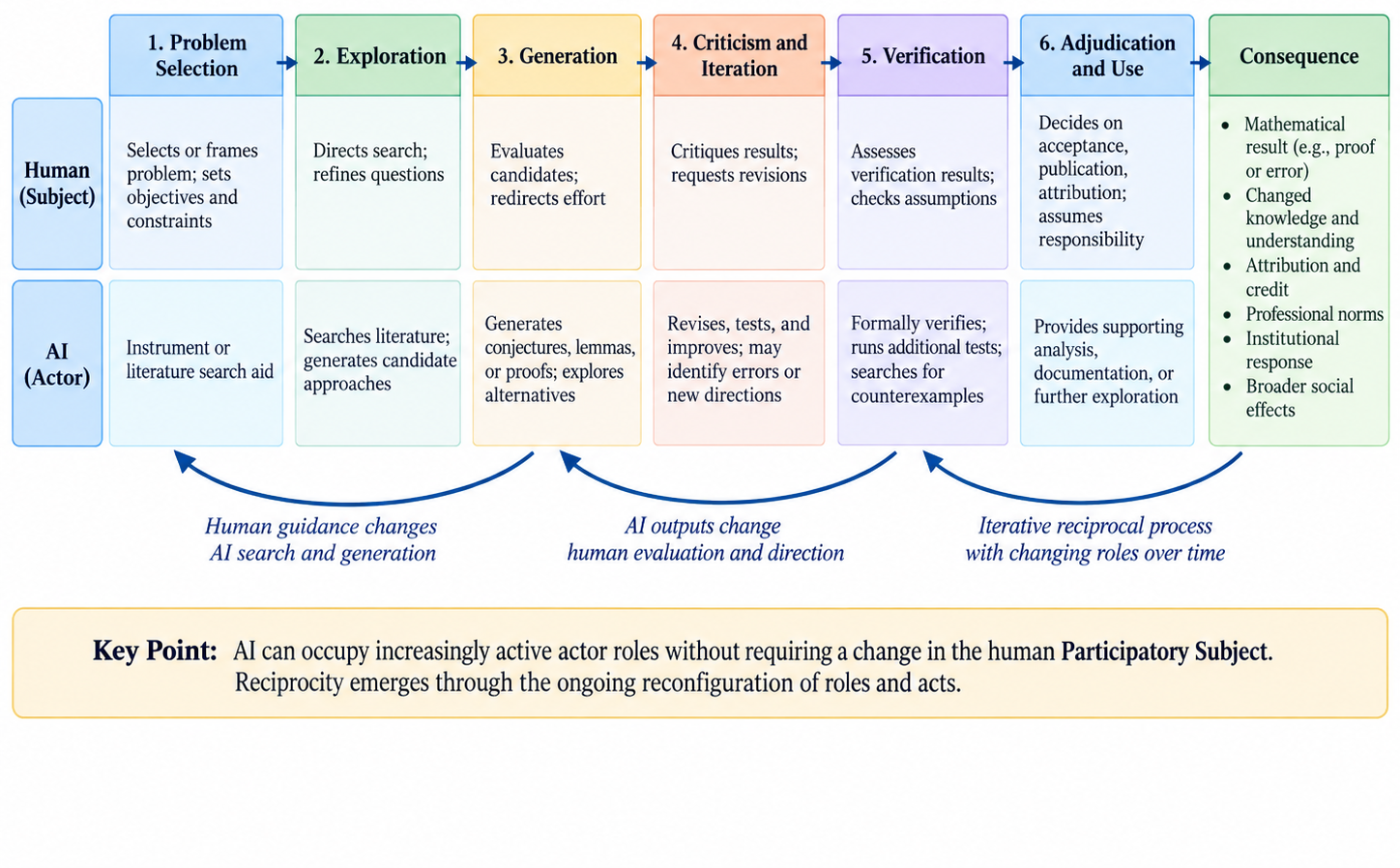
Figure 8.3. Reciprocal Role Plasticity in an AI-Assisted Mathematics Workflow. Schematic illustration of how human and AI actor roles may be redistributed across problem selection, search, generation, criticism, verification, and adjudication while the human Participatory Subject retains purposive and institutional responsibility. The figure abstracts the broader 2026 mathematics debate and does not assert the workflow, priority, provenance, or correctness of any specific contemporary result.
Reciprocity runs in both directions. AI participation can reallocate human tasks and alter what kinds of judgment, expertise, or coordination remain valuable; human Participation can in turn determine which problems are posed to AI, what evidence is accepted, how outputs are verified or attributed, what uses are permitted, and what institutional conditions govern subsequent AI work. This coupled movement of functions is one way reciprocity is instantiated through Participatory Role Plasticity.
8.7.4 Two local feedback paths¶
The first feedback path operates through the Subject. Earlier participation can change later readiness through education, organizational learning, translation, fatigue, overload, or withdrawal. The second operates through institutions: an act can create or close a procedure, response obligation, review process, information channel, or other return path through which later participation enters. These are temporal feedback paths, not a fourth Subject-Act-Consequence layer. When such a change satisfies the definition in §8.6.2, it is a Participatory Consequence at time t and part of the conditions inherited at t+1. A Configuration describes the participatory arrangement at a specified time or episode; it need not contain its own future feedback, although a later Configuration may reflect the resulting changed readiness or institutional route.
8.7.5 No universal participation stock¶
The traces left by participation are heterogeneous: knowledge, organizations, procedures, precedent, fatigue, exclusion, trust, distrust, expertise, and sometimes nothing detectable. Chapter 8 therefore does not introduce a cumulative participation stock that adds them into one scalar. Compression is permitted only where a later empirical application earns it.
8.7.6 Dynamic Participation and timing¶
Participatory Readiness can rise while revisability falls, a participatory form of the Collingridge dilemma (Collingridge 1980). A subject may become more capable of acting only after meaningful choices have narrowed. Conversely, rapid capability change can trigger learning, mobilization, new organizations, and professional attention rather than a simple readiness deficit. Whether human capacity develops early enough to meet consequential choices while they remain open is therefore an empirical synchronization question, not a theorem.
8.7.7 Boundary with Chapters 11 and 12¶
Chapter 8 does not need to develop the book-wide feedback and recursion architecture. That is Chapter 11’s burden; Chapter 12 will then integrate those recursive relations into the Unified Gradual AGI Model. Chapter 8 needs only the local result: Participatory Consequences can change later Subjects, capacities, institutional routes, and opportunities for action.
8.8 Participation and Realization¶
The preceding sections establish the reciprocal Participation thesis and the human-side analytic apparatus without assuming that human Participation changes realization. The final theoretical question is deliberately narrower and human-specific because it supplies the empirical bridge to Chapter 9: can human Participation sometimes become relevant to what is actually realized even when the participating subjects do not themselves possess formal veto or binding authority?
8.8.1 What is inherited¶
Participation does not introduce the general proposition that capability and realization are distinct; that is inherited from earlier chapters. Nor is it enough to show that formally empowered actors can constrain realization; Governance already covers that case. The Participation-specific extension concerns mediated pathways through which people lacking formal control can alter an intermediate condition encountered by actors who do possess authority.
8.8.2 Definition — Responsive Floor¶
Societal Floor. A societal Floor is the realized or assimilated state of a declared realization object for a declared population and domain: the level of realization that has become established in practice. It is the same kind of object as the CFS Floor Ft (§5.2), but it is not tied to the CFS recurrence. It need not be measured on a CFS metric or governed by CFS dynamics. Where an analysis does use CFS, Ft is one measured representation of the societal Floor, not a second Floor.
Participation-sensitive Floor (property). A societal Floor is participation-sensitive when one or more features of human Participatory Configuration contribute to differences in the path or configuration of its realization, including through participation by subjects lacking formal veto or binding authority. Participation-sensitivity is a property of the Floor, whether or not a given study can establish it.
Responsive Floor (classification). The book classifies a societal Floor as a Responsive Floor when, for a declared analysis, the evidence meets the pre-specified pathway or attribution standard for participation-sensitivity. Where the property may be present but the evidence does not meet that standard, the classification is unresolved (NotAdjudicated where an adjudication was attempted), not Responsive Floor by assertion.
Responsive is descriptive rather than commendatory. Meeting the pre-specified standard means that the evidence meets the declared pathway or attribution standard for the claim being made, not merely that participation is conceivable as a cause. A participatively responsive process can delay, accelerate, redirect, redistribute, exclude, or worsen outcomes. Responsiveness is not democracy, fairness, legitimacy, representativeness, welfare, or evidence that participants obtained what they wanted. Nor does the mere presence of hearings, petitions, protests, comments, organizations, or declarations establish a Responsive Floor.
8.8.3 Participation is not a fifth realization input¶
The realization architecture remains unchanged:
Rg(t) = μt(P(t), Av(t), Exg(t), Zd(t))
Participation is not appended as a fifth scalar argument. Its internal structure is heterogeneous: Subjects, Acts, grammar, configurations, and consequences. Participatory effects, where they exist, can enter realization by changing already recognized conditions or pathways—access, exposure, recourse, implementation conditions, availability, institutional arrangements, information, and later governance. Participation can therefore alter realization conditions without becoming another universal variable inside μt.
8.8.4 Proposition C — Participation-Sensitive Realization¶
Holding frontier capability and other relevant realization conditions sufficiently similar for comparison, differences in one or more pre-specified features of Participatory Configuration are admissible as possible sources of differences in realized societal Floors; the framework does not assume that this participatory dependence is universally present, nonzero, monotone, or large.
The word admissible is deliberate because Proposition C is architectural rather than an empirical prevalence claim. Its substantive work is to prevent the realization framework from excluding non-veto participatory dependence by construction: absence of formal veto is not, by itself, sufficient reason to remove a participatory feature from the candidate explanation set. Proposition C therefore creates an empirical burden rather than satisfying it. Literal identity among comparison cases is unnecessary and usually impossible, but capability, infrastructure, law, financing, exposure, commercial incentives, organizational capacity, formal authority, and other competing explanations must be considered before attributing a realization difference to Participation. If no domain supplies adequate evidence, no Responsive Floor finding follows.
The conditions Proposition C holds similar are baseline conditions, measured before the participatory acts being compared. Capability, infrastructure, law, financing, formal authority and the other competing explanations listed above must be comparable at that point. The intermediate conditions through which Participation is said to work (access, exposure, recourse, implementation conditions and institutional arrangements after the act) are not held fixed. They are the pathway, and §8.8.6 requires them to be traced. Proposition C’s target is therefore the total participatory contribution through those pathways. A claim about a direct contribution, conditional on a given intermediate condition, would be a different and stronger claim, requiring its own design.
8.8.5 The distinctive burden: non-veto participation¶
If realization changes only when the participating actor already possesses formal authority to impose the change, the Participation extension collapses into Governance or an inherited gate mechanism. The distinctive case is mediated influence: a participant alters information, incentives, access, organization, or another intermediate condition; an authorized actor subsequently changes realization while retaining the binding authority.
Participatory Act → changed intermediate condition → authorized decision → changed realization
The source of participatory input and the holder of binding authority must not be reassigned retrospectively. The participant can be realization-relevant without becoming the governor.
8.8.6 Pathways must be traced¶
A plausible story is not enough. A credible mediated-pathway claim asks whether the act occurred; whether it reached an identifiable recipient; whether meaningful alternatives remained available or later revisable; whether the relevant content entered the consequential process; whether an authorized actor subsequently changed something; whether documentary or other evidence links the change to the participatory input; and whether major competing explanations can be distinguished. Failure at a downstream link does not erase an established act. It weakens the realization-contribution claim.
8.8.7 No monotonicity, symmetry, or guaranteed direction¶
More Participation need not produce more realization effect. Large campaigns can arrive after foreclosure; small numbers of acts can enter highly consequential decision points. Oppositional participation can delay realization while supportive participation fails to accelerate it. An opposition campaign can increase publicity; a safeguard proposal can unintentionally create new barriers. The framework therefore assumes neither monotonicity nor symmetry, and Realization Orientation does not determine the sign of the eventual effect.
8.8.8 The contemporary mathematics cases are unevenly resolved¶
The contemporary mathematics cases occupy different positions on the Act-Recognition-Uptake-Consequence sequence. AHM membership, its member commitments, and AI-free-caucus participation are clearly observable Participatory Acts; whether each act achieved consequential Recognition beyond the association depends on the relevant recipient and record and should not be presumed. The Fields Medallists declaration is both an observable Act and an act that entered a public register, satisfying Recognition in the broad sense used here, while downstream institutional Uptake and realization contribution remain open. The September Mathathon episode provides a stronger bounded sequence: an open letter from current and former Caltech mathematicians called for suspension of an AI-intensive mathematics event (Coalition of current and former Caltech mathematicians 2026); the organizers publicly acknowledged several concerns as valid and revised the event design, including a longer verification period, an educational track, an explicit arXiv-publication requirement for the verification round, and faculty review of future public statements (Mathathon Organizers 2026). That is evidence of Recognition, Uptake, and a Participatory Consequence in the form of changed institutional procedure. The observed consequence is procedural/design change, not yet a demonstrated change in realized mathematical output. It does not by itself identify the counterfactual contribution of the letter, establish a domain-wide Responsive Floor, or settle the broader debate over AI in mathematics. The case family is useful precisely because it contains different stopping points rather than one uniform outcome.
8.8.9 Contraction¶
A credible Responsive Floor theory must permit the answer to be no. The extension should contract when pre-specified tests repeatedly fail to show pathway or explanatory information beyond capability, exposure, authority, infrastructure, law, commercial conditions, and other relevant determinants, or when every apparent non-veto pathway reduces to an exercise of formal authority already captured by Governance. Chapter 8 specifies the form of failure; Chapter 9 owns the empirical thresholds, comparison procedures, and evidence grades used to adjudicate it. The framework should contract rather than rescue the claim.
8.9 What Participation Can—and Cannot—Claim¶
Chapter 8 began with a simple problem: institutional possibility does not tell us whether anyone acts, what kind of act occurs, or what follows. It now places that human-side problem inside a broader reciprocal thesis: Gradual AGI is increasingly realized through interacting AI and human participation, with each side capable of changing the roles, conditions, and subsequent participation of the other. The Subject-Act-Consequence framework represents the human side without collapsing capacity into action, action into influence, influence into consequence, or consequence into realization.
8.9.1 Three propositions, three burdens¶
Proposition A supplies the principal analytic comparison rule: visible sameness does not establish equivalence when a pre-specified material difference remains in RO, FP, or AD. Proposition B rejects the deterministic inference from task automation to disappearance of every human participant function while leaving genuine contraction or elimination admissible. Proposition C is a meta-theoretical admissibility proposition: it keeps non-veto participatory dependence inside the realization framework’s candidate explanation space while assigning any actual Responsive Floor claim to empirical pathway evidence. Their evidentiary statuses are intentionally unequal.
8.9.2 Permanent nonclaims¶
The permanent boundaries can be stated compactly: capacity is not action; action is not Recognition or Uptake; processing is not consequence; and consequence is not realization change. Volume does not establish equivalence, AD does not establish prestige or correctness, Role Plasticity does not conserve human control, and Responsive Floor does not mean democracy or welfare. Reciprocal Participation does not imply symmetry, equivalent agency, equivalent intentionality, or value preservation. Reciprocal Participation also does not require symmetrical subjecthood: an AI system may occupy an active actor role without thereby becoming equivalent to the human Participatory Subject represented by this chapter’s human-side apparatus. Participation remains outside the realization mapping as a universal fifth input, and the framework defines no universal participation score or stock.
8.9.3 Contraction rule¶
The framework should contract where its distinctions fail to earn their analytical cost. At the conceptual level, failure means redundancy, inability to reproduce classifications under a prospectively declared protocol, or repeated collapse of a proposed distinction into an already-owned object such as Governance. At the empirical level, exact reliability thresholds, comparison rules, and evidence grades belong to Chapter 9 and domain-specific studies. Conditional Non-Fungibility, Role Plasticity, and Responsive Floor should therefore be refined, bounded, demoted, merged, or retired when their pre-declared tests fail—not preserved by post hoc reinterpretation.
8.9.4 Genealogy and originality boundary¶
The framework is deliberately antecedent-rich. Readiness has a distant formal analogy with Aristotle’s potentiality/actuality distinction (Aristotle n.d.), but its operative social-scientific lineage lies in civic participation and voluntarism (Verba and Nie 1972; Brady, Verba, and Schlozman 1995) and in work showing how institutional design and power condition participation (Cooke and Kothari 2001; Fung 2006; Gaventa 2006). Foreclosure Position is closer to traditions concerned with whether meaningful options remain open, including environmental-participation and public-law practice such as the Aarhus Convention (1998). Actor Dependence resonates with representation and experiential-knowledge arguments associated with Mansbridge (1999). Arnstein’s ladder of citizen participation (Arnstein 1969) is the canonical antecedent for separating participation from power, and so for Recognition ≠ Uptake. These are antecedents and analogies, not claims that the book simply renames those concepts.
Role Plasticity sits near meaningful-human-control and responsibility-gap work associated with Santoni de Sio and van den Hoven (2018) and Matthias (2004); local recursion is compatible with policy-feedback traditions associated with Pierson (1993) and Campbell (2012); Hirschman (1970) supplies an antecedent for exit and voice; and Austin (1962) helps preserve the distinction between an act and its effects. The book’s originality claim therefore remains narrow: the contribution is the realization-centered integration of Subject, Act, and Consequence; the minimal RO/FP/AD grammar; Conditional Non-Fungibility; and an evidence-conditioned Responsive Floor extension with explicit failure conditions, all situated inside a reciprocal human-AI Participation thesis that does not presume symmetry between the two sides.
8.9.5 Handoff to empirical contact¶
A conceptual architecture can remain elegant while failing under observation. Its categories may prove unreliable; its distinctions may be redundant; its proposed pathways may be absent; nulls may dominate; or real cases may force revision. The next chapter therefore changes the burden of proof from conceptual admissibility to empirical survival.
Chapter 8 defines the reciprocal Participation thesis and the human-side distinctions that make it empirically tractable. Chapter 9 asks which of those human-side distinctions survive empirical contact while treating reciprocal human-AI reconfiguration as an explicitly prospective extension rather than silently importing it into the frozen Frame One design. That prospective extension includes reciprocal role plasticity: the redistribution and mutual conditioning of human and AI actor roles within shared realization processes.
References and Contemporary Source Notes¶
Aarhus Convention. 1998. Convention on Access to Information, Public Participation in Decision-Making and Access to Justice in Environmental Matters.
Aristotle. n.d. Metaphysics, Book Θ (Theta): Potentiality and Actuality.
Arnstein, Sherry R. 1969. “A Ladder of Citizen Participation.” Journal of the American Institute of Planners 35(4): 216–224.
Association for Human Mathematics (AHM). 2026. “Home,” “Members,” and member commitments. Accessed September 11-12, 2026. https://www.ahmath.org/
Austin, J. L. 1962. How to Do Things with Words. Oxford: Clarendon Press.
Brady, Henry E., Sidney Verba, and Kay Lehman Schlozman. 1995. “Beyond SES: A Resource Model of Political Participation.” American Political Science Review 89(2): 271-294.
Campbell, Andrea Louise. 2012. “Policy Makes Mass Politics.” Annual Review of Political Science 15: 333-351.
Coalition of current and former Caltech mathematicians. 2026. “Open Letter about the Mathathon.” Proofs and Prompts, September 10, 2026. Accessed September 15, 2026. https://proofsandprompts.com/2026/09/10/open-letter-about-the-mathathon/
Collingridge, David. 1980. The Social Control of Technology. London: Frances Pinter.
Cooke, Bill, and Uma Kothari, eds. 2001. Participation: The New Tyranny? London: Zed Books.
European Mathematical Society. 2026. “Leiden Declaration on Artificial Intelligence and Mathematics.” August 5, 2026. Accessed September 15, 2026. https://euromathsoc.org/news/leiden-declaration-on-artificial-intelligence-and-mathematics-224
Fields Medallists (twenty-five signatories, including Artur Avila, Manjul Bhargava, Pierre Deligne, Terence Tao, Maryna Viazovska and Efim Zelmanov). 2026. “A Severe Misalignment of AI in Mathematics.” Declaration, September 11, 2026. Zenodo. https://doi.org/10.5281/zenodo.22737750. Also posted at https://mathandai.org/.
Fung, Archon. 2006. “Varieties of Participation in Complex Governance.” Public Administration Review 66(s1): 66-75.
Gaventa, John. 2006. “Finding the Spaces for Change: A Power Analysis.” IDS Bulletin 37(6): 23-33.
Hirschman, Albert O. 1970. Exit, Voice, and Loyalty. Cambridge, MA: Harvard University Press.
Leiden Declaration on Artificial Intelligence and Mathematics. 2026. June 2, 2026. DOI 10.5281/zenodo.20302944. Accessed September 15, 2026. https://leidendeclaration.ai/
London Mathematical Society. 2026. “Artificial Intelligence.” Publications policy, updated June 2026. Accessed September 15, 2026. https://www.lms.ac.uk/publications/policies/AI
Mansbridge, Jane. 1999. “Should Blacks Represent Blacks and Women Represent Women? A Contingent ‘Yes’.” Journal of Politics 61(3): 628-657.
Mathathon Organizers. 2026. “A Response from Mathathon.” Proofs and Prompts, September 10, 2026. Accessed September 15, 2026. https://proofsandprompts.com/2026/09/10/a-response-from-mathathon/
Matthias, Andreas. 2004. “The Responsibility Gap: Ascribing Responsibility for the Actions of Learning Automata.” Ethics and Information Technology 6: 175-183.
Pierson, Paul. 1993. “When Effect Becomes Cause: Policy Feedback and Political Change.” World Politics 45(4): 595-628.
Santoni de Sio, Filippo, and Jeroen van den Hoven. 2018. “Meaningful Human Control over Autonomous Systems: A Philosophical Account.” Frontiers in Robotics and AI 5:15.
Schuler, Marcus. 2026. “25 Fields Medalists Say AI Labs’ Race to Solve Math Problems Is Harming Mathematics.” Implicator, September 13, 2026. https://www.implicator.ai/25-fields-medalists-say-ai-labs-race-to-solve-math-problems-is-harming-mathematics/.
Verba, Sidney, and Norman H. Nie. 1972. Participation in America: Political Democracy and Social Equality. New York: Harper & Row.
W.H.L., GPT-5.6 Sol, and Claude Sonnet 5. 2026m. “Gradual AGI as Participation: Subjects, Acts, and Consequences.” Gradual AGI Series #9, Publication Version v1.0, August 27, 2026. Champaign Magazine. https://champaignmagazine.com/2026/08/27/gradual-agi-as-participation-subjects-acts-and-consequences/